
What Do Young Workers Actually Need?
All Talk No Action
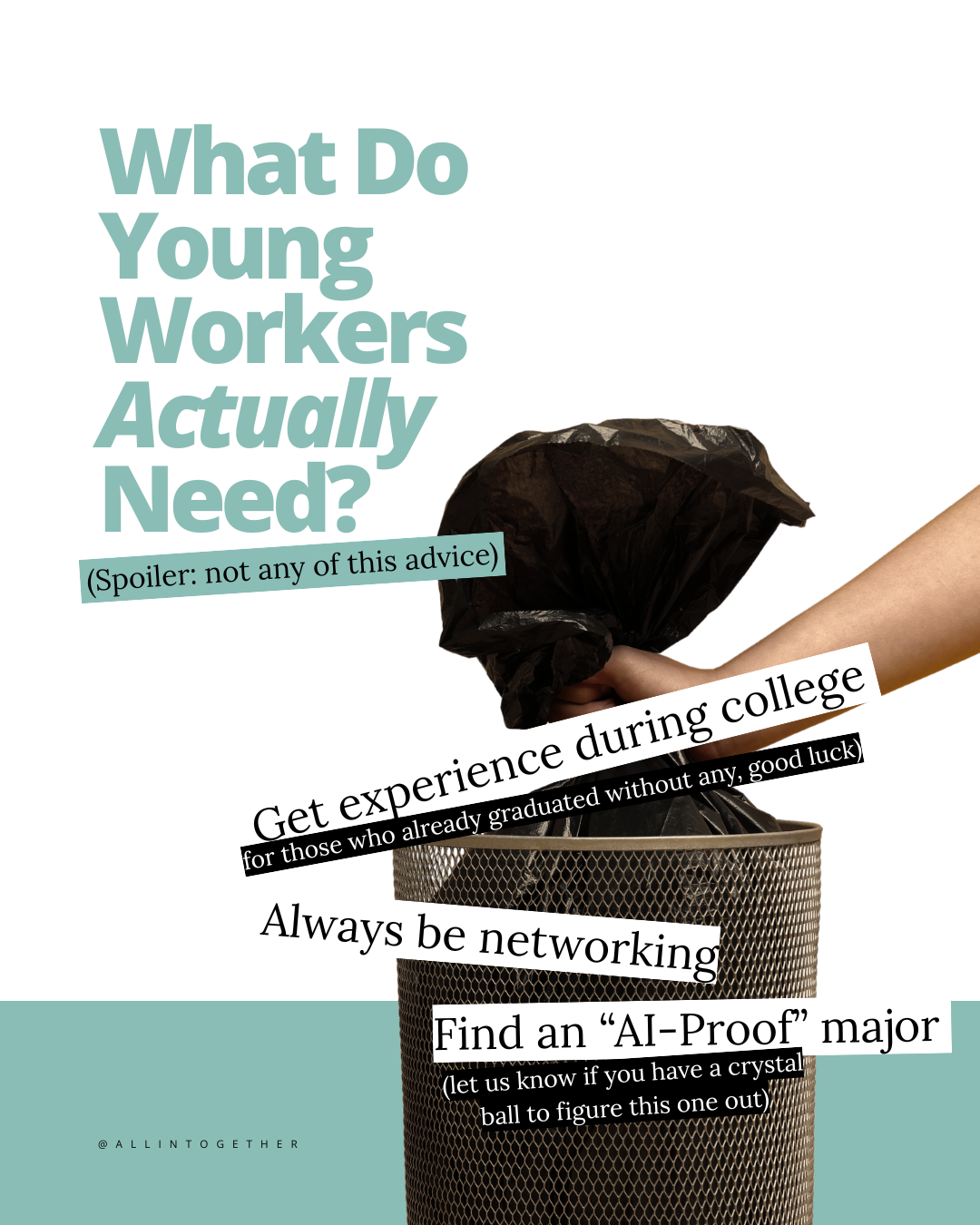
How we feel about trending career advice. Credit: the amazing Makehers Studio
Every day, it seems there is a new article telling young people in the job market how to land a job fast. But for many young people navigating hiring and building a career, most of this advice is either too late or impossible to follow.
Get experience during college (for those who already graduated without any, good luck)
Always be networking
Find an “AI-Proof” major (let us know if you have a crystal ball to figure this one out)
When I was applying for jobs right out of college back in 2018, the landscape wasn’t great either. I probably sent out over 50 applications, landed just a handful of interviews, and got 2 offers, taking 1 (at All In Together). For my colleague Emily in 2023, the numbers were similar. But for some more recent grads, the numbers can be even more skewed, with 100s of applications and a dismal few responses. The stats for 2026 grads will likely be the same or worse, and the same holds for anyone searching for an entry- or early-career job.
The Landscape: Too Few Opportunities, Too Much Competition
The ZipRecruiter 2026 Graduate Report shows that more people are applying for fewer entry-level jobs. The percentage of entry-level positions in overall job openings is shrinking, and the number of applicants per job opening is increasing. However, in a bright spot, 77% of recent grads landed a job within three months.
Yet, youth unemployment is still higher than for other age groups (13.7% for 16-19 year olds and 6.4% for 20-24 year olds compared to 4.3%), and while college degrees help close that gap, this is still the highest unemployment level for college-educated young people in over a decade aside from the Pandemic. And all of these stats obscure the number of young people who’ve just stopped looking for work. The labor force participation rate for 20-24 year olds is 70.5%, compared to 83.8% for 25-54 year olds.
The Problem: Employment ≠ Financial Independence
According to the 2026 Wells Fargo money study, 64% of parents of Gen Z adults report their children rely on them for financial support, and more than half of those parents say this support strains their own finances.
That’s because for many young Americans, landing a job may still mean struggling to cover rent, delaying major life milestones, or relying on family support. That helps explain why economic anxiety looms so large.
The most recent Yale Youth Poll shows that the cost of living is the top issue for young people, while Next Gen’s text conversations with young voters found that concerns about inflation, wages, and housing are shaping daily decision-making. The quotes Next Gen highlights are particularly damning. A whole generation of young people who feel they did everything they were “supposed to do” and got none of the promised rewards.
So what’s the solution?
It’s not surprising that young people are trying to reimagine work itself. There is a huge desire for entrepreneurship and self-employment, but not the millennial hustle-culture version. Young people are adapting to a shifting labor market, developing multiple revenue streams, and taking control of their economic future.
But this isn’t an option for most young people. Now more than ever, getting into the right rooms matters. Corporations need to understand how and why our economic and labor institutions aren’t working for young people, and young people need real pathways to a career, not the same recycled career advice.
That’s why programs like Rising Voices matter. Next week, we are bringing young people into conversation with those leading hiring and workforce policies at major companies. We’re not asking whether young people are ready for work. We’re asking whether our institutions, employers, and economic systems are ready for them. Instead of the same repetitive advice, we’re providing real insights, real guidance, and opportunities to build a supportive network. Join us.